
Mathematics Pathways
There are three distinct mathematics course outcomes in the IB Diploma Program that students may achieve at The York School, which correspond to different requirements at the university level:
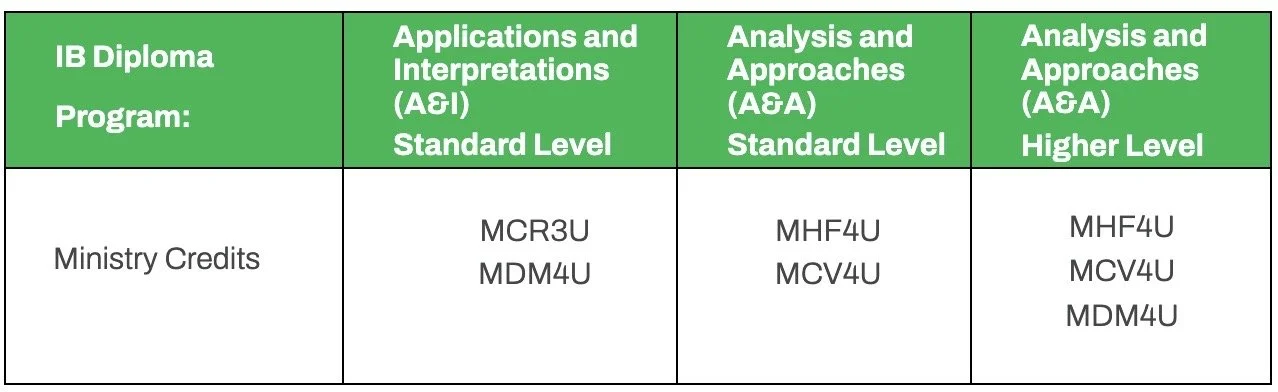
Applications and Interpretations (Standard Level) is intended for students who are likely to take Arts/Humanities at the university level, may benefit from some grounding in statistics, but do not require a course in Calculus.
Analysis and Approaches (Standard and Higher Level) is intended for students heading toward any of the following programs: Sciences, Mathematics, Business, Architecture or Engineering and who will require a calculus course credit as a prerequisite to those programs. Higher level is recommended for students who contemplate Mathematics or Engineering.
For each of these outcomes, there are corresponding math courses/credits required:
Recognizing the depth and rigor of the IB Diploma Programme in Mathematics, The York School has elected to accelerate students’ learning in this discipline. Beginning in Grade 8, students will complete the Grade 9 Ontario Mathematics credit (MTH1W) as part of their regular program.
New students entering Grade 9 (2026 and beyond) will be placed in an accelerated Mathematics pathway designed to support the successful completion of both the Grade 9 credit (MTH1W) and the Grade 10 credit (MPM2D).
For students who prefer a non-accelerated option, The York School also offers a developmentally appropriate Mathematics sequence. This pathway prepares learners for the IB Diploma Program’s SL Applications and Interpretations (A&I) course in Grades 11 and 12.
As we transition to this revised approach, please refer to the table below for the Mathematics pathway options available to each graduating cohort.
Mathematics pathways:
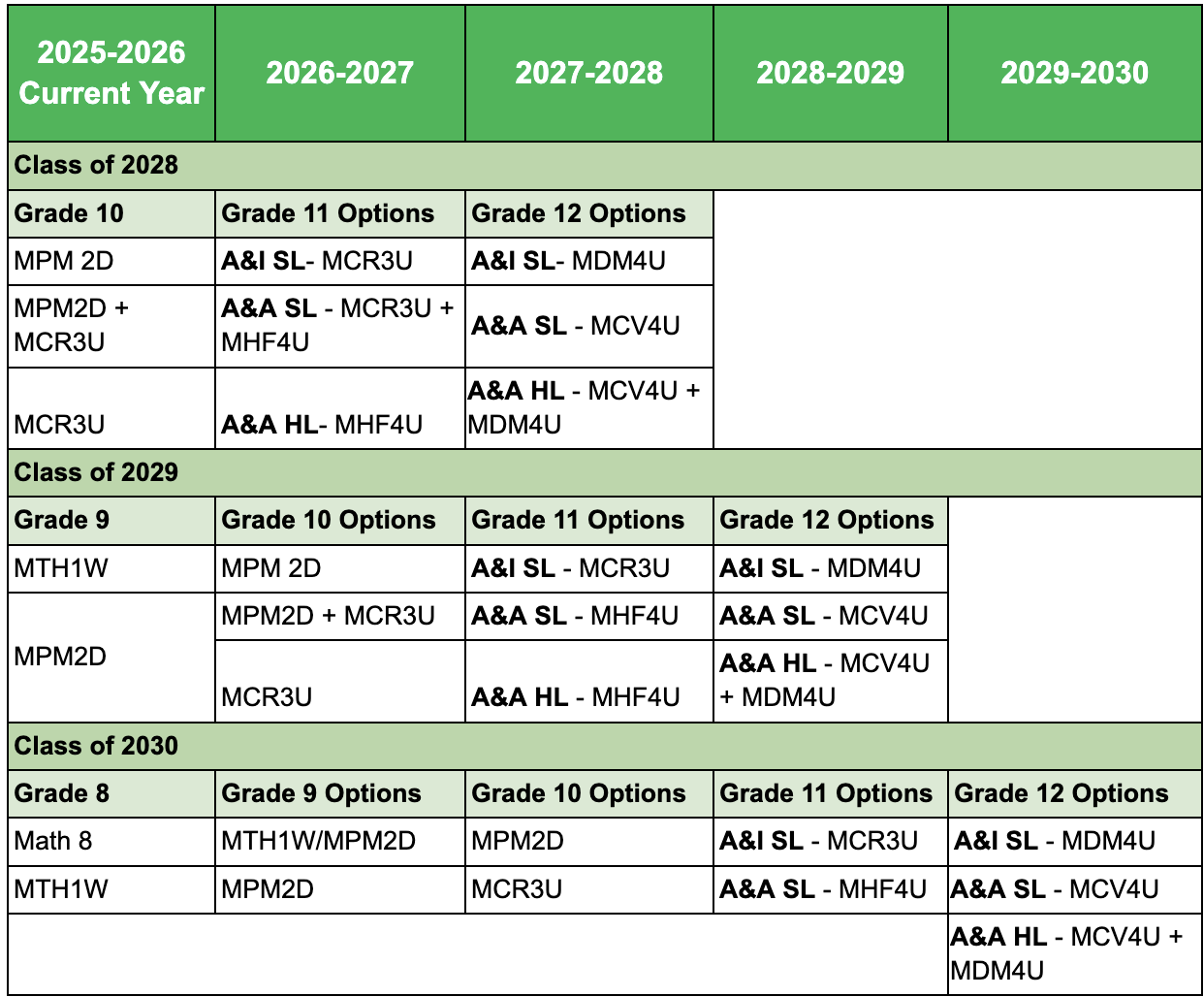
For the Class of 2028, the implication of taking double math in Grade 11 is that students receive one more credit by the end of high school but have a heavier course load in Grade 11 as a result.
The implication of taking double math in Grade 10 is that the student will not be eligible to take “Applications and Interpretations” in Grades 11 and 12. The students will have one less course in Grade 11, giving students a spare. The other implication is that the student is not able to take the Grade 10 Design course.
Grades 11 and 12: the Diploma Years
In choosing courses for Grades 11 and 12, most students will have to select courses keeping in mind the requirements of the International Baccalaureate program. Students who choose to follow the Personalized Pathway Program will have to bear in mind the requirements of the Ontario Secondary School Diploma. Students should note that certain departments (Mathematics and Science) recommend minimum required marks for entering higher level courses; these are noted in the “IB Description” for the subject. Finally, all students in Grade 11 and 12 must follow the Theory of Knowledge course in order to be eligible to receive the IB Diploma.
Each student and their parents must meet with their university counsellor to ensure that course selections are appropriate in terms of both the IB requirements and post-secondary objectives.
In making their course selections, students are encouraged to discuss individual courses with teachers and speak with their university counsellor. Ontario curriculum policy documents are available on the Ontario government website: http://www.edu.gov.on.ca/eng/teachers/curriculum.html
Mathematics
Principles of Mathematics Grade 9, De-streamed (MTH1W)
This course enables students to develop an understanding of mathematical concepts related to algebra, analytic geometry, and measurement and geometry through investigation, the effective use of technology, and abstract reasoning. Students will investigate relationships, which they will then generalize as equations of lines, and will determine the connections between different representations of a linear relation. They will also explore relationships that emerge from the measurement of three-dimensional figures and two-dimensional shapes. Students will reason mathematically and communicate their thinking as they solve multi-step problems.
Prerequisite: None
Principles of Mathematics Grade 10, Academic (MPM2D)
This course enables students to broaden their understanding of relationships and extend their problem-solving and algebraic skills through investigation, the effective use of technology, and abstract reasoning. Students will explore quadratic relations and their applications; solve and apply linear systems; verify properties of geometric figures using analytic geometry; and investigate the trigonometry of right and acute triangles. Students will reason mathematically and communicate their thinking as they solve multi-step problems.
Prerequisite: Mathematics Grade 9, de-streamed
IB Description
The MYP Mathematics Grade 9 and 10 courses at The York School are designed for students of all academic abilities. The main objectives of the program supports the IB learner profile by providing lessons and inquiry based projects and activities that nurture the development of students who are knowledgeable, inquirers, communicators and reflective learners.
The aim of the MYP mathematics program is to provide students with the skills needed to address further courses in mathematics and prepare them for the use of this domain in their workplace and life in general. Students will develop problem solving strategies and reasoning skills that will enable them to think critically and make logical decisions.
Students learn to use the “language” of mathematics to express their thinking in different ways and appreciate that it is a mode of communication that can cross cultural and language barriers.
Mathematics has applications in many other subject areas such as science, technology, economics and social sciences and links to other subjects and real-life situations are developed as much as possible. Students reflect on how mathematical concepts are applied in a wide variety of real-life situations.
Through sustained inquiry in mathematics, students are developing conceptual understanding of global contexts. This understanding helps students to discover that mathematics is a universal language embedded in all cultures, and helps them to learn how to solve problems, analyse issues and evaluate decisions that may have an impact on themselves, their communities or the wider world. Thus building on all three fundamental concepts identified by IB: holistic learning, communications and intercultural understanding.
Grades 11 and 12
Functions Grade 11, University Preparation (MCR3U)
This course introduces the mathematical concept of the function by extending students’ experiences with linear and quadratic relations. Students will investigate properties of discrete and continuous functions, including trigonometric and exponential functions; represent functions numerically, algebraically, and graphically; solve problems involving applications of functions; investigate inverse functions; and develop facility in determining equivalent algebraic expressions. Students will reason mathematically and communicate their thinking as they solve multi-step problems.
Prerequisite: Principles of Mathematics Grade 10, Academic
Advanced Functions Grade 12, University Preparation (MHF4U) (taken in Grade 11)
This course extends students’ experience with functions. Students will investigate the properties of polynomial, rational, logarithmic, and trigonometric functions; broaden their understanding of rates of change; and develop facility in applying these concepts and skills. Students will also refine their use of the mathematical processes necessary for success in senior mathematics. This course is intended both for students taking the Calculus and Vectors course as a prerequisite for a university program and for those wishing to consolidate their understanding of mathematics before proceeding to any one of a variety of university programs.
Prerequisite: Functions Grade 11, University Preparation, or Mathematics for College Technology Grade 12, College Preparation
Mathematics of Data Management Grade 12, University Preparation (MDM4U) (taken in Grade 12)
This course broadens students’ understanding of mathematics as it relates to managing information. Students will apply methods for organizing large amounts of information; apply counting techniques, probability, and statistics in modeling and solving problems; and carry out a culminating project that integrates the expectations of the course and encourages perseverance and independence. Students will also refine their use of mathematical processes necessary for success in senior mathematics. Students planning to pursue university in business, the social sciences, or the humanities will find this course of particular interest.
Prerequisite: Functions and Relations Grade 11, University Preparation, or Functions Grade 11, University/College Preparation
Calculus and Vectors Grade 12, University Preparation (MCV4U) (taken in Grade 12)
This course builds on students’ previous experience with functions and their developing understanding of rates of change. Students will solve problems involving geometric and algebraic representations of vectors and representations of lines and planes in three dimensional space; broaden their understanding of rates of change to include the derivatives of polynomial, sinusoidal, exponential, rational, and radical functions; and apply these concepts and skills to the modeling of real-world relationships. Students will also refine their use of the mathematical processes necessary for success in senior mathematics. This course is intended for students who choose to pursue careers in fields such as science, engineering, economics, and some areas of business, including those students who will be required to take a university-level calculus, linear algebra, or physics course.
Note: The Advanced Functions course (MHF4U) must be taken prior to or concurrently with Calculus and Vectors (MCV4U).
IB Description
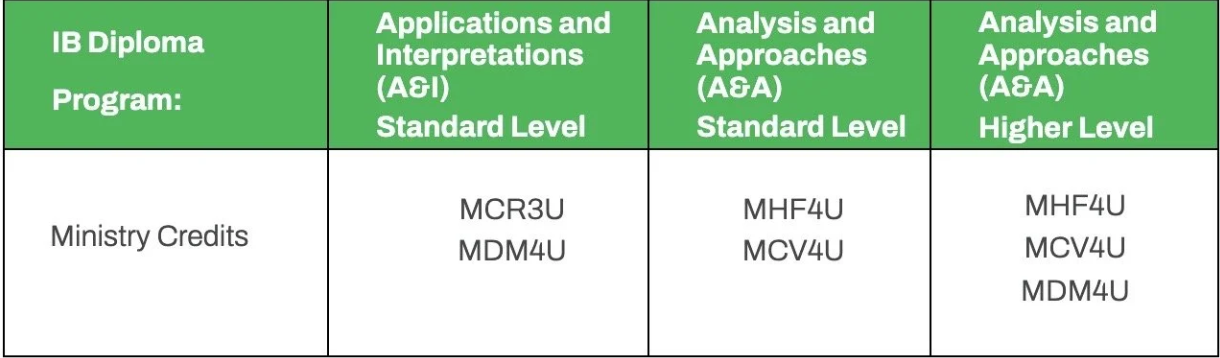
At The York School, the IB Diploma Mathematics program features three different offerings, each of which combines different Ministry of Education credit courses.
Applications and Interpretations Standard Level
Applications and Interpretations Standard Level Mathematics is offered for students who do not anticipate a need for mathematics in their further studies. A math exploration is a mandatory part of the course (worth 20%) where the student completes an individual written piece of work involving the collection and/or generation of data, and the analysis and evaluation of the information or measurements. Assessment is based on the project and two one-and-a-half hour external examinations (worth 40% each). Students take Functions (MCR3U) in their first year and Mathematics of Data Management (MDM4U) in their second year.
Analysis and Approaches Standard Level
Analysis and Approaches Standard Level Mathematics is suitable for students who have experienced a fair measure of success in mathematics - 75% or better at year's end - and who are quite capable in a considerable range of analytical and technical skills. Students who are taking Analysis and Approaches Standard Level Mathematics are normally intending to pursue university studies in areas such as Economics, Business, or general Science where they will often be required to take additional math courses. This two-year university preparatory course introduces some financial applications of mathematics, extends students’ experiences with functions, and introduces second-degree relations. As part of their studies, students will be required to write a report called a ‘Mathematical Exploration’ that involves investigation of an area of mathematics of their choice (worth 20%). Assessment is based on the Exploration and two one-and-a-half hour external examinations (worth 40% each). Students take Functions (MCR3U) (unless already taken) and Advanced Functions (MHF4U) in their first year and Calculus and Vectors (MCV4U) in their second year.
Analysis and Approaches Higher Level
Analysis and Approaches Higher Level Mathematics is suitable for students who have experienced consistently high marks in mathematics - an average of 90% or better at year's end - and who are very competent in a wide range of analytical and technical skills. This is a challenging course for students who have demonstrated a strong work ethic and a real desire to explore math. Students taking Analysis and Approaches Higher Level Mathematics will be expected to include mathematics as a major component of their university studies, either as a subject in its own right or within courses such as physics, engineering and/or technology. Others may take this course because they have a strong interest in mathematics and enjoy meeting its challenges and engaging its problems. Analysis and Approaches Higher Level Mathematics is a two-year university preparatory course. As part of their studies, students will be required to write a report called a ‘Mathematical Exploration’ that involves investigation of an area of mathematics of their choice (worth 20%). Assessment is based on the exploration and three external examinations (two 2 hour exams worth 30% each and one 1-hour exam worth 20%). Students take Functions (MCR3U) (unless already taken) and Advanced Functions (MHF4U) in their first year and Calculus and Vectors (MCV4U) and Mathematics of Data Management (MDM4U) in their second year.