
The York School MYP Assessment Handbook
Principles of MYP Assessment
Assessment is central to learning and teaching at The York School, where teachers use a variety of assessment strategies and specific criteria to support student learning. Assessment practices are designed to be fair, transparent, and equitable, and to support all students in demonstrating their learning.
The MYP (Middle Years Program) is an International Baccalaureate framework that guides how we teach and assess learning.
Subject-specific assessment criteria: Students are introduced to subject-specific criteria and task-specific expectations at the outset so they understand what quality work looks like and how their learning will be assessed.
Assessment is ongoing: Teachers check understanding throughout every unit, not just at the end. This helps identify strengths, address gaps, and guide next steps in learning.
Assessment measures understanding: Students are asked not only to recall knowledge, but to apply it, make connections, and explain their thinking.
Feedback supports growth: Teachers provide specific, actionable feedback so students understand what they are doing well and what steps will help them improve.
How Are Students Assessed?
Assessment Types
Throughout the year, students complete both formative and summative assessments.
Formative assessment is used to monitor progress, provide feedback, and guide next steps in learning. This may include class discussions, practice tasks, drafts, conferences, reflections, observations, or quizzes. In keeping with Ontario’s policies and practices found in Growing Success, formative assessment is used as both assessment for learning and assessment as learning. It helps teachers adjust instruction and helps students reflect on their progress, respond to feedback, and improve their learning. Students are expected to use feedback from formative assessment to refine their understanding and improve their learning and work over time.
Summative assessment, or assessment of learning, is used to evaluate student learning within a unit. It provides students with an opportunity to demonstrate what they know, understand, and can do. These assessments can take many forms, including tests, essays, conversations, presentations, labs, performances, and projects. In the MYP, summative tasks are assessed using subject-specific criteria, and these results are used to determine a student’s overall achievement in the course.
Assessment Criteria and Rubrics
Criteria-based assessment: In MYP courses, students are assessed against clearly defined subject-specific criteria. Unlike norm-referenced models, where students are measured against their peers, MYP assessment measures achievement against shared standards. This ensures a fair and consistent approach to evaluating student learning.
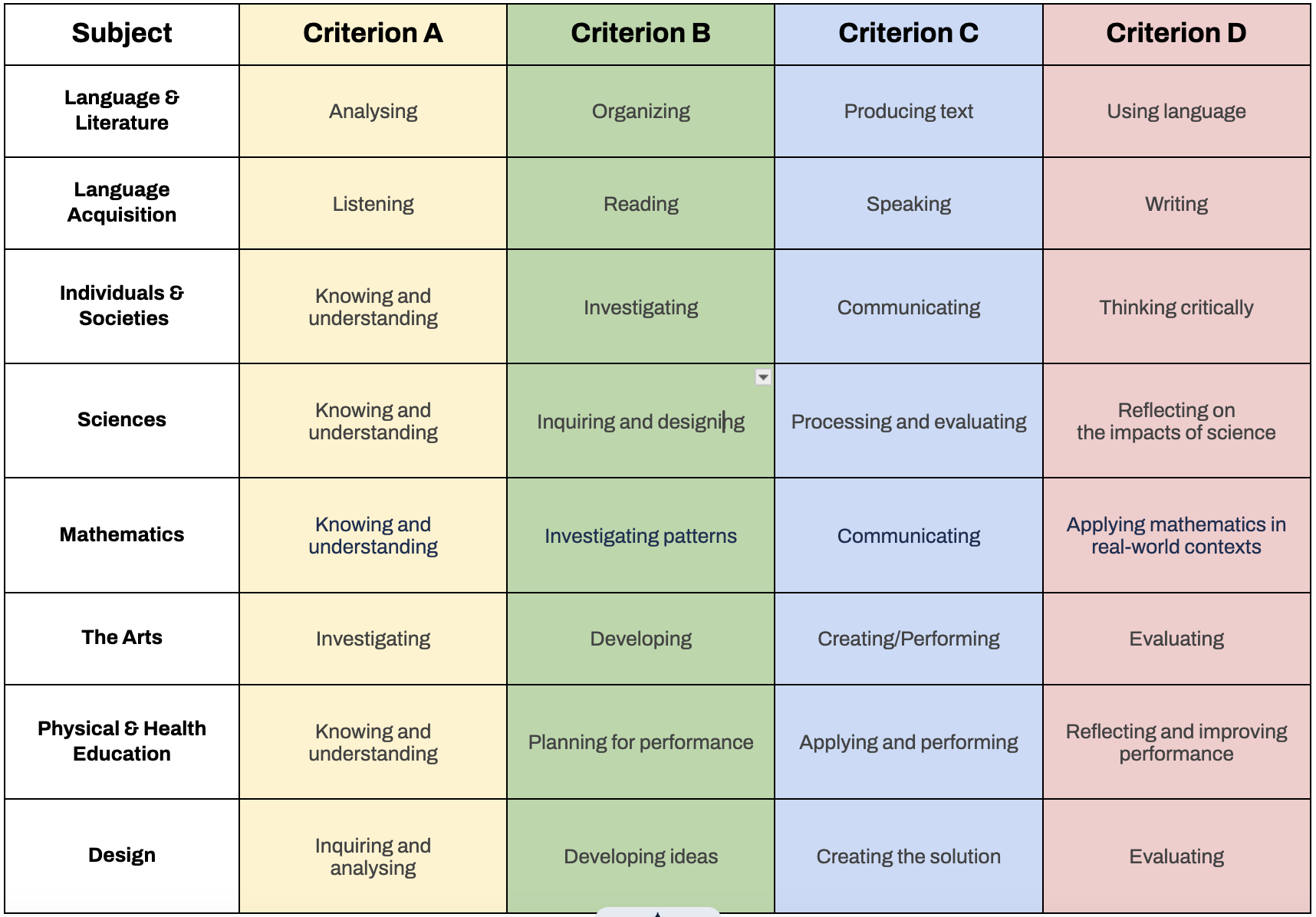
Each subject group within the MYP has 4 subject-specific criteria (A, B, C, and D), each focusing on a different aspect of learning within the discipline. Teachers will assess students according to each of these criteria at least twice throughout the year.
Determining Student Achievement/Assessment
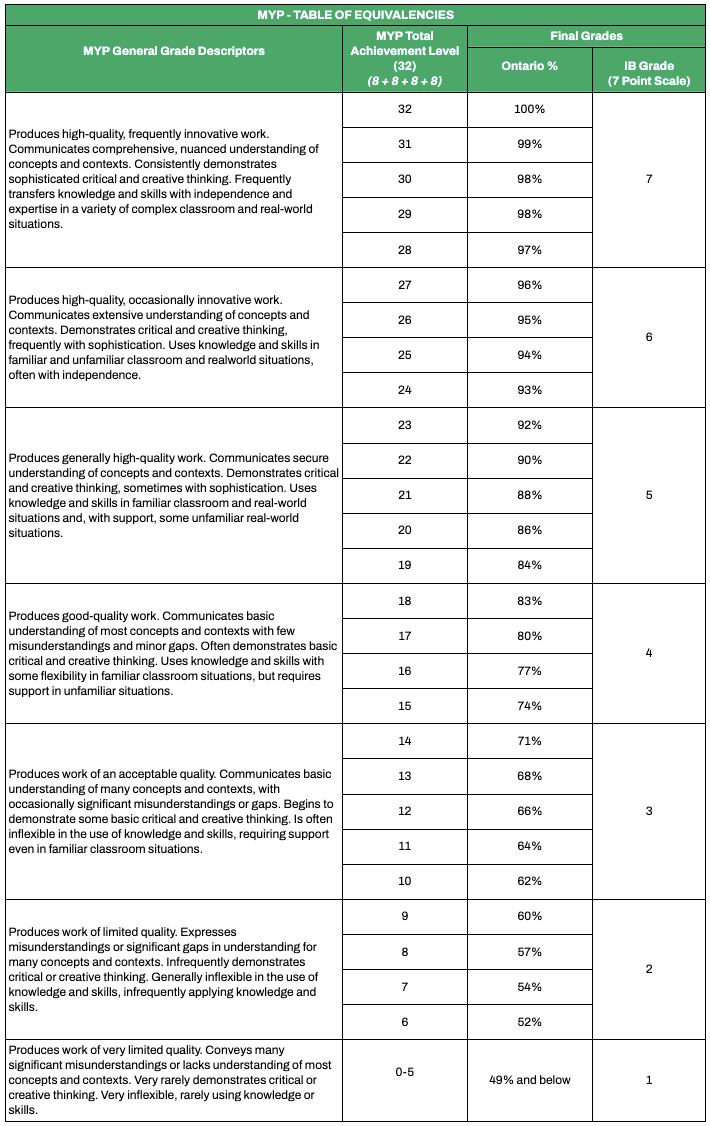
Each criterion has eight achievement levels. At the end of the reporting period, the four criterion levels are added together to produce a total achievement level out of 32. This total corresponds to an IB grade from 1–7 and an Ontario percentage using The York School’s MYP Table of Equivalencies.
For example:
At the end of the reporting period in Grade 7 Science, a student’s achievement levels for each criterion are determined based on the body of coursework completed. If a student demonstrates:
4 in Criterion A
5 in Criterion B
4 in Criterion C
5 in Criterion D
These levels are added together for a total of 18/32. A total of 18 corresponds to a final IB grade of 4 which is equivalent to 83% in Ontario reporting.

In Grade 9 and Grade 10 credit courses—and in the Grade 9 mathematics credit course taken in Grade 8—this percentage represents the coursework component of the final grade. The final Ontario percentage also includes the Ministry-mandated final evaluation and attendance and participation components described later in this handbook.
MYP and Ontario Table of Equivalent Grades
The table below shows how MYP assessment scores (1-32) translate to IB grades (1-7) and Ontario percentages.
Best-fit approach: Teachers use professional judgment to determine each MYP criterion achievement level based on patterns in student learning over time. Rather than averaging individual criterion scores, teachers consider the most consistent and most recent evidence of learning. In Ontario credit courses, the percentage generated from this MYP coursework assessment is then combined with the mandatory final-evaluation and attendance and participation components using the provincially prescribed weights.
How MYP Assessment Criterion Connect to Ontario Achievement Categories: At The York School, we assess student learning using both the IB Middle Years Programme (MYP) criteria (A, B, C, and D) and the Ontario Achievement Chart categories: Knowledge and Understanding, Thinking, Communication, and Application.
These frameworks are closely connected and reflect many of the same skills. While there is no direct one-to-one match, the general alignment is as follows:
Criterion A (Knowing and Understanding / Analysing / Investigating / Listening) → Knowledge and Understanding
Criterion B (Organizing / Investigating / Inquiring / Planning / Developing) → Thinking
Criterion C (Communicating / Producing / Speaking / Creating / Performing) → Communication
Criterion D (Applying / Writing / Thinking Critically / Reflecting / Evaluating) → Application
Students often demonstrate learning across multiple categories at the same time. For example, a project may involve applying knowledge (Application), analyzing ideas (Thinking), and clearly presenting understanding (Communication). This integrated approach ensures that student achievement reflects both the rigor of the MYP and the expectations of the Ontario curriculum.
Ontario Credit Courses: Final Grades, Attendance and Written Examinations
Beginning in the 2026–2027 school year, the Ontario Ministry of Education has introduced a new policy for the calculation and reporting of final grades in Grade 9 and Grade 10 credit courses.
At The York School, these requirements apply to:
all Grade 9 and Grade 10 credit courses; and
the Grade 9 mathematics credit course taken by students in Grade 8.
They do not apply to Grade 7 courses or to the other Grade 8 courses.
These requirements do not change how students demonstrate learning through the MYP criteria. Students will continue to receive criterion-based feedback and achievement levels using the four MYP subject-specific criteria. The Ministry requirements affect how the final Ontario percentage is calculated and reported for credit courses.

Coursework and MYP Assessment
The coursework component is determined using the MYP assessment process described in this handbook. Teachers use the MYP criteria and a best-fit approach to determine a student’s achievement based on the body of evidence collected throughout the course.
The resulting MYP achievement level is converted to an Ontario percentage using The York School’s MYP Table of Equivalencies. For credit courses, this percentage contributes 65% of the final Ontario course grade.
Attendance and Participation
Beginning in the 2026–2027 school year, attendance and participation contribute 15% of the final grade.
Regular attendance and active participation in the School’s in-person learning program are important parts of student learning. Students are expected to attend classes regularly and punctually and to engage in the learning activities and assessments established for their courses.
Attendance and participation will be addressed in accordance with Ministry policy requirements and The York School’s Student Attendance Policy.
Written Examinations and Final Evaluations
Most Grade 9 and Grade 10 credit courses include a mandatory final evaluation worth 20% of the final course grade. The composition of this final evaluation depends on the subject:
In English, mathematics and science, the final evaluation is a written examination worth 20%.
In some other subjects, the 20% final evaluation is divided between a written examination and a culminating task.
Course outlines will identify the final-evaluation requirements that apply to each course.
The provincial requirements and subject-specific final-evaluation breakdowns are outlined in the Ministry’s updated Growing Success policy.
Report Card Timelines

What This Means for Students
Students will know what success looks like: Teachers share clear criteria and examples so students understand what they are working toward.
More opportunities to improve: Learning is a process. Feedback helps students understand what to do next, and they will often have chances to refine their work.
Reflection on progress: Students will be asked to think about what they understand, what challenges them, and how they are growing as a learner.
Developing a range of skills: Assessment focuses not only on what students know, but also how they think, communicate, and apply their learning across subjects.
Growth over time matters: Teachers look at patterns in student work and use their most consistent and recent learning to determine their achievement.
What This Means for Parents
Focus on learning, not just grades: Ask your child about the criteria, feedback, and what they are working toward, not only the final result.
Value growth and effort: Progress, resilience, and the ability to use feedback are key indicators of success.
Expect a range of assessment types: Students demonstrate their learning in many ways (e.g., projects, presentations, tests), not just traditional exams.
Understand that achievement is based on evidence over time: MYP criterion levels reflect the most consistent and recent evidence of learning rather than an average of all tasks. In credit courses, the final Ontario percentage also includes the provincially required final evaluation and attendance and participation components.
Stay connected: Ongoing communication with teachers helps support your child’s learning. We work in partnership to support both academic growth and overall development.
References
International Baccalaureate Organization. MYP: From Principles into Practice (2014, updated 2022).
Ontario Ministry of Education. Growing Success: Assessment, Evaluation, and Reporting in Ontario Schools (2010).
Government of Ontario. (2022, June 29). Growing success: Assessment, evaluation and reporting in Ontario schools, kindergarten to Grade 12. https://www.ontario.ca/page/growing-success-assessment-evaluation-and-reporting-ontario-schools-kindergarten-grade-12