
MYP Assessment
Principles of MYP Assessment
Assessment is central to learning and teaching at The York School, where teachers use a variety of assessment strategies and specific criteria to support student learning. Assessment practices are designed to be fair, transparent, and equitable, and to support all students in demonstrating their learning.
The MYP (Middle Years Program) is an International Baccalaureate framework that guides how we teach and assess learning.
Subject-specific assessment criteria: Students are introduced to subject-specific criteria and task-specific expectations at the outset so they understand what quality work looks like and how their learning will be assessed.
Assessment is ongoing: Teachers check understanding throughout every unit, not just at the end. This helps identify strengths, address gaps, and guide next steps in learning.
Assessment measures understanding: Students are asked not only to recall knowledge, but to apply it, make connections, and explain their thinking.
Feedback supports growth: Teachers provide specific, actionable feedback so students understand what they are doing well and what steps will help them improve.
How Are Students Assessed?

Assessment Types
Throughout the year, students complete both formative and summative assessments.
Formative assessment is used to monitor progress, provide feedback, and guide next steps in learning. This may include class discussions, practice tasks, drafts, conferences, reflections, observations, or quizzes. In keeping with Ontario’s policies and practices found in Growing Success, formative assessment is used as both assessment for learning and assessment as learning. It helps teachers adjust instruction and helps students reflect on their progress, respond to feedback, and improve their learning. Students are expected to use feedback from formative assessment to refine their understanding and improve their learning and work over time.
Summative assessment, or assessment of learning, is used to evaluate student learning within a unit. It provides students with an opportunity to demonstrate what they know, understand, and can do. These assessments can take many forms, including tests, essays, conversations, presentations, labs, performances, and projects. In the MYP, summative tasks are assessed using subject-specific criteria, and these results are used to determine a student’s overall achievement in the course.
Assessment Criteria and Rubrics
Criteria-based assessment: In MYP courses, students are assessed against clearly defined subject-specific criteria. Unlike norm-referenced models, where students are measured against their peers, MYP assessment measures achievement against shared standards. This ensures a fair and consistent approach to evaluating student learning.
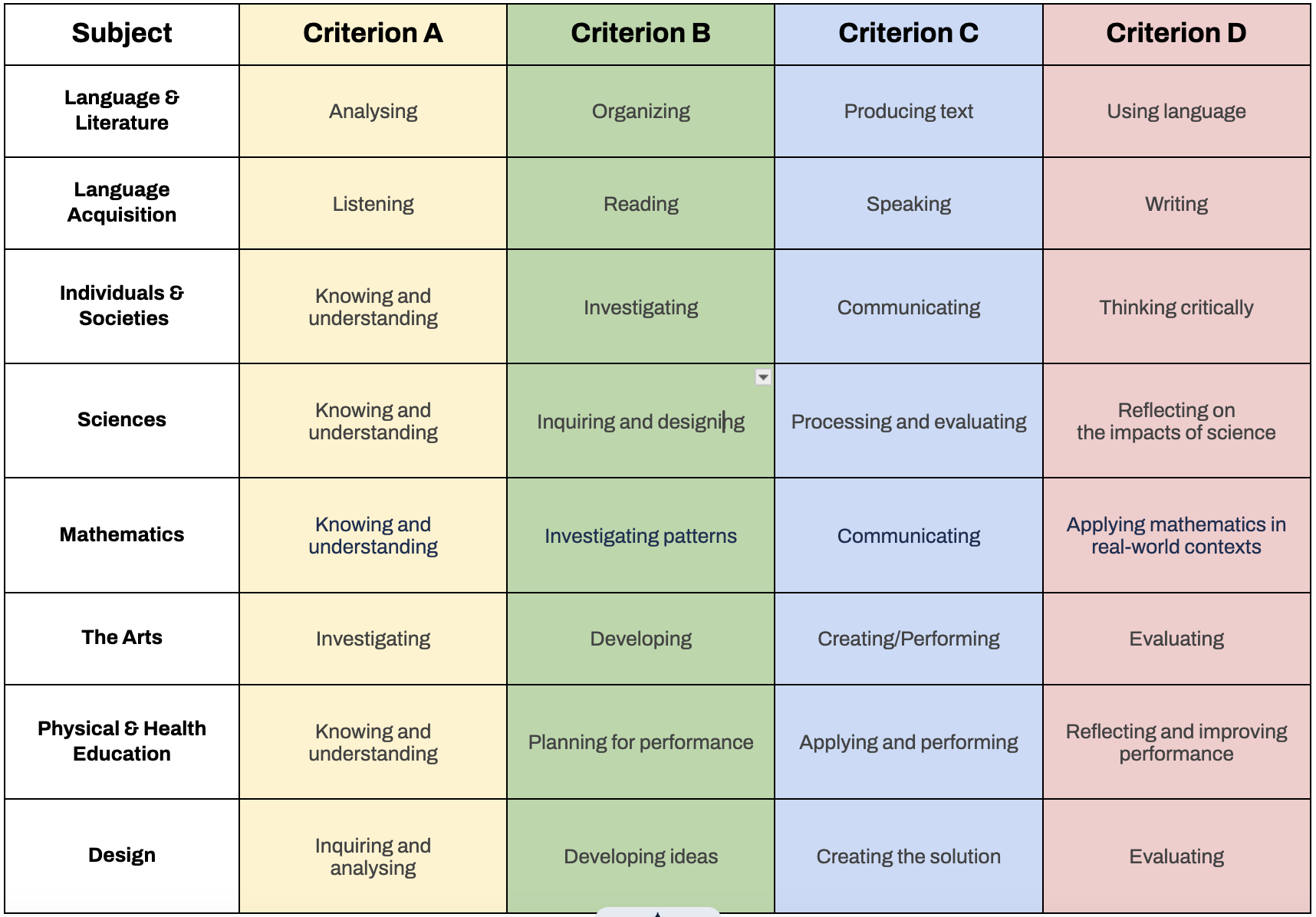
Each subject group within the MYP has 4 subject-specific criteria (A, B, C, and D), each focusing on a different aspect of learning within the discipline. Teachers will assess students according to each of these criteria at least twice throughout the year.
Determining Student Achievement/Assessment
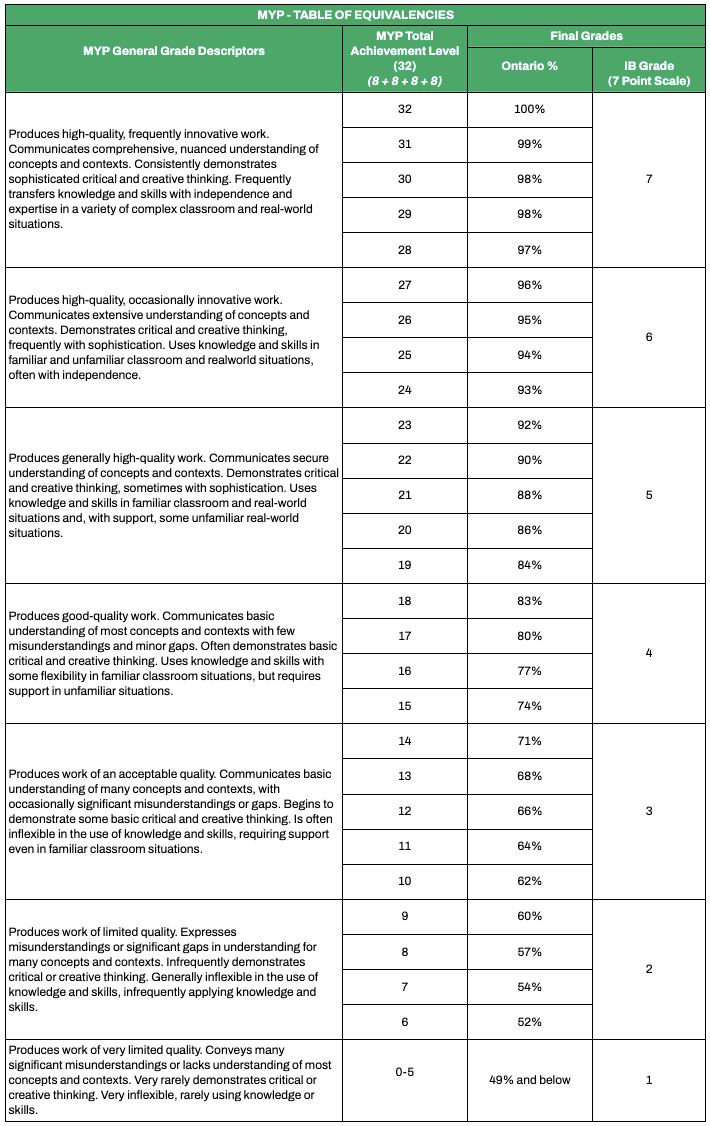
Each criterion has eight achievement levels. At the end of the reporting period, the four criterion levels are added together to produce a total achievement level out of 32. This total corresponds to an IB grade from 1–7 and an Ontario percentage using The York School’s MYP Table of Equivalencies.
For example:
At the end of the reporting period in Grade 7 Science, a student’s achievement levels for each criterion are determined based on the body of coursework completed. If a student demonstrates:
4 in Criterion A
5 in Criterion B
4 in Criterion C
5 in Criterion D
These levels are added together for a total of 18/32. A total of 18 corresponds to a final IB grade of 4 which is equivalent to 83% in Ontario reporting.

In Grade 9 and Grade 10 credit courses—and in the Grade 9 mathematics credit course taken in Grade 8—this percentage represents the coursework component of the final grade. The final Ontario percentage also includes the Ministry-mandated final evaluation and attendance and participation components described later in this handbook.
MYP and Ontario Table of Equivalent Grades
The table below shows how MYP assessment scores (1-32) translate to IB grades (1-7) and Ontario percentages.
Best-fit approach: Teachers use professional judgment to determine each MYP criterion achievement level based on patterns in student learning over time. Rather than averaging individual criterion scores, teachers consider the most consistent and most recent evidence of learning. In Ontario credit courses, the percentage generated from this MYP coursework assessment is then combined with the mandatory final-evaluation and attendance and participation components using the provincially prescribed weights.
How MYP Assessment Criterion Connect to Ontario Achievement Categories: At The York School, we assess student learning using both the IB Middle Years Programme (MYP) criteria (A, B, C, and D) and the Ontario Achievement Chart categories: Knowledge and Understanding, Thinking, Communication, and Application.
These frameworks are closely connected and reflect many of the same skills. While there is no direct one-to-one match, the general alignment is as follows:
Criterion A (Knowing and Understanding / Analysing / Investigating / Listening) → Knowledge and Understanding
Criterion B (Organizing / Investigating / Inquiring / Planning / Developing) → Thinking
Criterion C (Communicating / Producing / Speaking / Creating / Performing) → Communication
Criterion D (Applying / Writing / Thinking Critically / Reflecting / Evaluating) → Application
Students often demonstrate learning across multiple categories at the same time. For example, a project may involve applying knowledge (Application), analyzing ideas (Thinking), and clearly presenting understanding (Communication). This integrated approach ensures that student achievement reflects both the rigor of the MYP and the expectations of the Ontario curriculum.
Ontario Credit Courses: Final Grades, Attendance and Written Examinations
Beginning in the 2026–2027 school year, the Ontario Ministry of Education has introduced a new policy for the calculation and reporting of final grades in Grade 9 and Grade 10 credit courses.
At The York School, these requirements apply to:
all Grade 9 and Grade 10 credit courses; and
the Grade 9 mathematics credit course taken by students in Grade 8.
They do not apply to Grade 7 courses or to the other Grade 8 courses.
These requirements do not change how students demonstrate learning through the MYP criteria. Students will continue to receive criterion-based feedback and achievement levels using the four MYP subject-specific criteria. The Ministry requirements affect how the final Ontario percentage is calculated and reported for credit courses.

Coursework and MYP Assessment
The coursework component is determined using the MYP assessment process described in this handbook. Teachers use the MYP criteria and a best-fit approach to determine a student’s achievement based on the body of evidence collected throughout the course.
The resulting MYP achievement level is converted to an Ontario percentage using The York School’s MYP Table of Equivalencies. For credit courses, this percentage contributes 65% of the final Ontario course grade.
Attendance and Participation
Beginning in the 2026–2027 school year, attendance and participation contribute 15% of the final grade.
Regular attendance and active participation in the School’s in-person learning program are important parts of student learning. Students are expected to attend classes regularly and punctually and to engage in the learning activities and assessments established for their courses.
Attendance and participation will be addressed in accordance with Ministry policy requirements and The York School’s Student Attendance Policy.
Written Examinations and Final Evaluations
Most Grade 9 and Grade 10 credit courses include a mandatory final evaluation worth 20% of the final course grade. The composition of this final evaluation depends on the subject:
In English, mathematics and science, the final evaluation is a written examination worth 20%.
In some other subjects, the 20% final evaluation is divided between a written examination and a culminating task.
Course outlines will identify the final-evaluation requirements that apply to each course.
The provincial requirements and subject-specific final-evaluation breakdowns are outlined in the Ministry’s updated Growing Success policy.
Report Card Timelines

What This Means for Students
Students will know what success looks like: Teachers share clear criteria and examples so students understand what they are working toward.
More opportunities to improve: Learning is a process. Feedback helps students understand what to do next, and they will often have chances to refine their work.
Reflection on progress: Students will be asked to think about what they understand, what challenges them, and how they are growing as a learner.
Developing a range of skills: Assessment focuses not only on what students know, but also how they think, communicate, and apply their learning across subjects.
Growth over time matters: Teachers look at patterns in student work and use their most consistent and recent learning to determine their achievement.
What This Means for Parents
Focus on learning, not just grades: Ask your child about the criteria, feedback, and what they are working toward, not only the final result.
Value growth and effort: Progress, resilience, and the ability to use feedback are key indicators of success.
Expect a range of assessment types: Students demonstrate their learning in many ways (e.g., projects, presentations, tests), not just traditional exams.
Understand that achievement is based on evidence over time: MYP criterion levels reflect the most consistent and recent evidence of learning rather than an average of all tasks. In credit courses, the final Ontario percentage also includes the provincially required final evaluation and attendance and participation components.
Stay connected: Ongoing communication with teachers helps support your child’s learning. We work in partnership to support both academic growth and overall development.
References
International Baccalaureate Organization. MYP: From Principles into Practice (2014, updated 2022).
Ontario Ministry of Education. Growing Success: Assessment, Evaluation, and Reporting in Ontario Schools (2010).
Government of Ontario. (2022, June 29). Growing success: Assessment, evaluation and reporting in Ontario schools, kindergarten to Grade 12. https://www.ontario.ca/page/growing-success-assessment-evaluation-and-reporting-ontario-schools-kindergarten-grade-12
DP Assessment
The mechanics of assessing and evaluating student performance at The York School is guided by the principles set out below. Our policy is informed by the Ministry of Education’s Growing Success document, and by relevant IB guidelines.
Frequent and Meaningful Feedback
Student performance is assessed on a frequent basis and receives meaningful feedback in order that students can make appropriate adjustments to their learning and performance behaviours.
Assessment for Learning
Students are given the opportunity to attempt new skills and demonstrate recent learning on a trial basis without fear of their first attempts affecting their overall grade at the end of the year.
Assessment as Learning
Students will be guided to independence as learners by helping them develop their ability to set goals and assess their own performance and the performance of others.
Assessment of Learning
Once a student has had opportunities to demonstrate their learning and has received feedback, they are then assessed, and the results of that assessment are recorded for final evaluative purposes.
Variety of Assessment Tools
Students are subject to a wide range of assessment types that are engineered to test students’ knowledge and understanding of a subject, as well as their abilities to think, inquire, communicate, and apply their knowledge. Such assessments are appropriate to the specific skills and content of the subject area, but also give students the opportunity to utilize the wide range of intelligences that they bring to the subject.
Assessment practices ensure there is evidence of student achievement from three different sources - observations, conversations, and products.Teachers take this evidence into account when determining the final grade.
Criteria-Based Evaluations
Student performance is evaluated in terms of criteria that is presented to the students ahead of time, and is based on the achievement level descriptions set out in the Ministry of Education documents, and where appropriate, on the descriptions set out in IB guidelines.
Evaluation: Current Measure of a Student’s Potential based on Consistent Performance
Evaluation is the process of judging the quality of student learning on the basis of established criteria and assigning a value to represent that quality. Evaluation is based on assessments of learning that provide data on student achievement at strategic times throughout the grade/subject/course, often at the end of a period of learning (Growing Success). Thus, the mark a student receives at the end of the year is based on evidence of past performance, with due regard being given to both consistency and the most recent achievement levels attained.
Learning Skills
Learning skills are assessed through teacher observations, collecting evidence during tasks associated with a unit, and teacher created tracking documents etc.
Evaluation: Expectations vs. Learning Skills
Student grades represent a student’s ability to perform with respect to expectations specified in subject-specific guidelines published by the Ministry of Education, and where appropriate, by the IB. A student’s demonstration of learning skills not forming part of such expectations are evaluated separately as “learning skills” and do not influence a student’s overall grade.
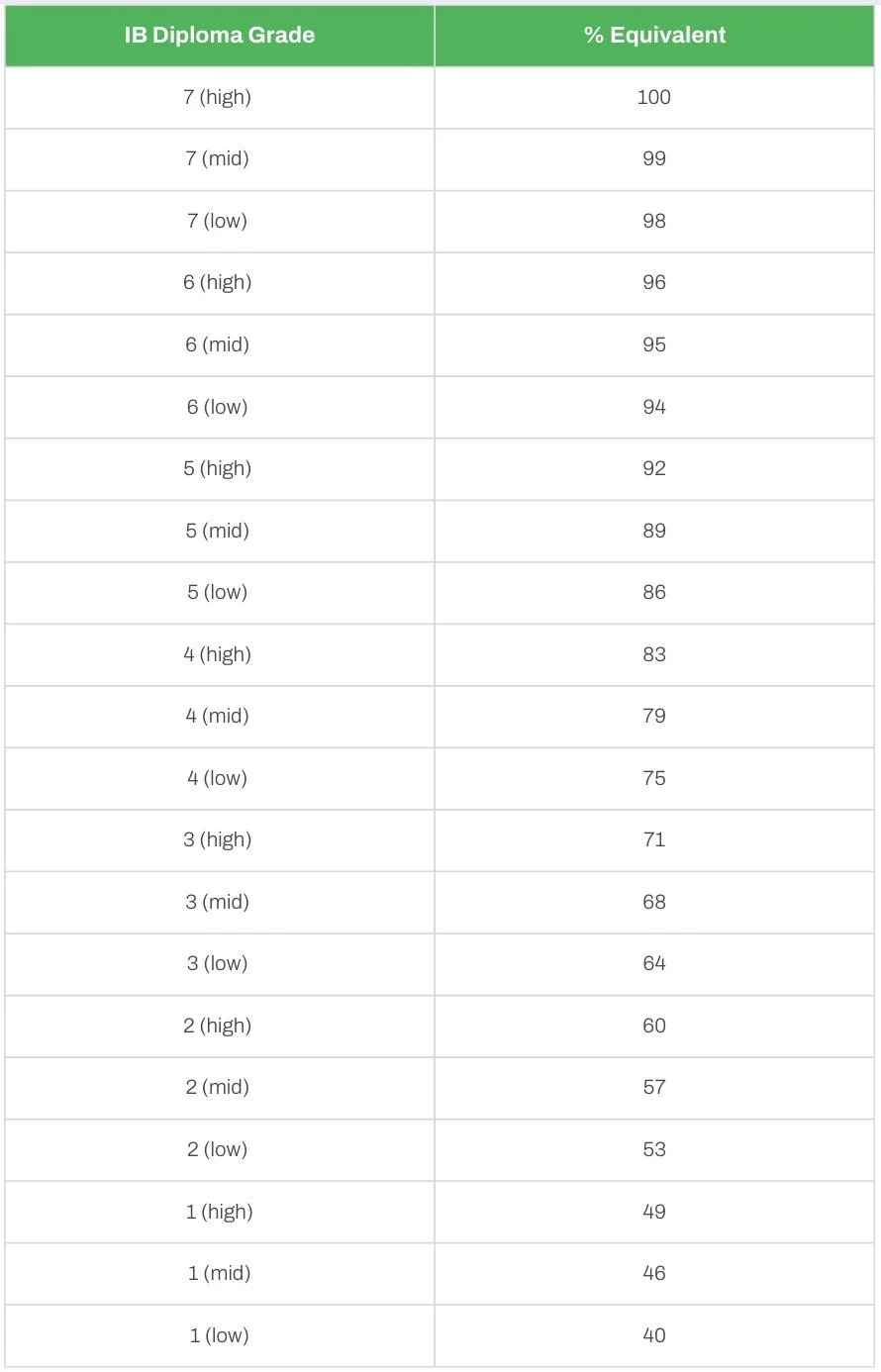
IB Diploma Scale and IBSO Ontario Table of Equivalency
MYP and DP: Late, Incomplete or Unsubmitted Assessments
Students are given due dates for assignments and set fixed dates for performances and tests. In setting due dates teachers make reference to a shared assessment calendar and are guided to choose dates that avoid giving students unmanageable work schedules.
Students are guided on how to calendarize their due dates and are expected to abide by all due dates, performance dates, and test dates. Where students encounter difficulties in managing their schedules, they are encouraged to speak with their advisor or the Learning Strategist. Students may communicate with a teacher to seek an extension of a due date where circumstances arise that are outside the student’s control and that make it impossible for the student to adhere to the published deadline. The decision to allow an extension of an assignment due date is at the teacher’s discretion in Grades 9 and 10. At Grades 11 and 12 the extension must be approved by the Principal. Except where a student is ill, no alternative dates will be granted to a student facing a performance or test date, except as may be allowed by the Principal.
Teachers will be guided by the following when faced with unexcused late, incomplete or unsubmitted summative assignments:
Where the assignment is not submitted the teacher shall assign either a zero or ‘no mark’, and in the determination of interim grades, may downgrade the assessment of the student’s overall achievement to account for the missing evidence, and in the determination of final grades, may exercise their professional judgement as to whether the missing evidence results in
a fail based on the student’s inability to demonstrate achievement of overall expectations,
a lower final mark,
or where the overall expectation(s) being assessed in the unsubmitted assessment has or have been assessed at another time, no mark penalty.
Where a summative assignment has been partially completed the teacher may assess the completed portion, and either register a resulting grade for the entire assessment or assess certain criteria and consider other criteria unsubmitted.
Where a summative assignment has not been handed in on time, the teacher would record a Late or Unsubmitted Assignment Infraction in York Net. This will notify the student and their parents of the unsubmitted work.
In Grades 9, where a summative assignment has not been handed in on time, the student will be required to attend the York Workspace (in the Leigh Centre for Wellbeing) at the end of the school day for one hour x 3 days, or until the assignment is complete and has been submitted to the teacher. Where a student is required to attend Workspace they may not attend any co-curricular activities during their Workspace time.
Grade 10, 11 and 12: Where a summative assignment has not been handed in by 8:30am on the day it is due, the student (and their parent) will be sent an email indicating that the student is to attend Workspace the following day from 8:00am until 5:00pm in order to complete the assignment Students may resume classes once they submit the assignment. Students who have not completed the assignment by 5:00pm will have until 8:30am the next day to complete and submit the assignment.
Specific Guidelines for the Assessment of Grade 11 and 12 Work
Assessment tools
Teachers will base all formal assessments on IB DP tasks. Examples of IB DP tasks include portfolios, lab reports, orals and past examination papers.
Non-IB (Ontario) tasks may be useful in assisting student learning, but this will be restricted to assessment for learning or may be given lesser weight in determining a final report card mark or predicted grade.
Grading
Students will be assigned an IB grade for each piece of formally-assessed IB work. This grade will be on the 1-7 scale for tests, and will use the appropriate subject-specific rubric(s). Internal Assessment work may be graded on a different scale depending upon the subject-specific rubrics used. Teachers may indicate where in the grade level the student work falls (low/mid/high), but will not award a specific Ontario percentage to a single piece of work.
Determination of mid-term grades (DP1 only)
From September through December of the Grade 11 year, a variety of non-IB assessment tasks may be used to assist student learning. When midterm grades are determined for report cards during this period, student marks may therefore be based on a combination of IB and non-IB assessment tasks. The table of equivalences may be used for any assessments that are IB tasks. The determination of a percentage mark for non-IB assessment tasks is left to the individual teacher’s professional judgement.
Determination of final/interim grades
Interim/final grades for IB students are determined in June of the Grade 11 year and at various points throughout the Grade 12 year. At these times, teachers will determine an appropriate IB Grade (1-7) on the basis of past performance, with particular regard being given to IB tasks and to most recent and most consistent performance. An equivalent Ontario percentage will be determined using the table of equivalences. In determining the final report card mark for Grade 12, the final IB results will represent 30% of the total, and the 70% will be derived from the student’s performance on summative tasks during the year.
MYP & DP: Guidelines for Offering Re-tests and Re-dos
In forming their professional judgement with respect to whether and how a re-test or re-do is to be offered, the teacher will be guided by the following considerations.
If a teacher is considering offering a re-test or re-do for a portion or all of the class for reasons not relating to personal circumstances of individuals in the cohort, they must first speak with their course partners and agree as to whether a re-test or re-do is to be done, and how it should be done.
Where a re-test or re-do is offered to some for non-personal reasons, it should be offered to all.
Where any re-test or re-do situation occurs, there must be a plan for re-learning; that plan may differ according to the learning needs of the individual student, and the plan for relearning should be set out in a TRAIL mail.
When a student decides to do a re-test or re-do, their result on the later attempt should replace the result in the earlier attempt.
A re-test should be held within a week of the first attempt.
Whether the re-test occurs within or outside the class time will be at the discretion of the teacher.
It will be at the discretion of the teacher as to what portions of a test or assignment are redone and whether a different form of assessment is used in the second attempt.
Personal circumstances that are relevant to consider in an application by an individual for a re-test should extend only to matters outside of the student’s control.