
Two Pathways to Graduation (Grades 11 & 12)
IB Diploma Program
Course selection according to the IB “Placemat” requirements, including standard ratio of standard level (SL) and higher level (HL) courses
Extended Essay
Creativity, Activity, Service (CAS)
Theory of Knowledge (TOK)
Full course load required
Students graduate with an IB Diploma and the Ontario Secondary School Diploma (OSSD)
Personalized Pathway Program
Students learn in the same class cohorts with their IB DP peers
Greater flexibility in course selection (i.e., not restricted to the IB “Placemat”)
Extended Essay not required
CAS not required (40 hrs. OSSD community service requirement remains)
Theory of Knowledge (TOK)
Full course load required
Students graduate with an IB Course Transcript and the Ontario Secondary School Diploma (OSSD)
The IB Diploma Program (11 & 12) - DP
The York School is authorized to offer the International Baccalaureate (IB) Diploma Program (DP) as the final two years of Senior School study. Many students follow the full DP, while others choose to complete only IB courses, following York’s Personalized Pathway Program, described below. Courses in Grades 11 and 12 are designed to meet both Ontario requirements and those of the IB DP. Students who are successful in their courses will receive Ontario credits and, assuming they meet all other Ontario requirements, will receive the Ontario Secondary School Diploma (OSSD). Students who are successful in their IB DP courses and fulfill all the additional requirements of the IB DP will receive the IB Diploma, a superior qualification for national and international university entrance. Students in the Personalized Pathway program will receive an IB Course transcript.
The IB DP offers a diverse and balanced curriculum. Diploma candidates are required to study one subject from each of six areas.
The Diploma courses currently offered at York are:
Group 1: Studies in Language and Literature (English Literature, English Language and Literature)
Group 2: Language Acquisition (French B, Spanish B, Spanish ab initio, Mandarin B or Mandarin ab initio)
Group 3: Individuals and Societies (Economics, Geography, History, Business Management and Environmental Systems & Societies*)
Group 4: Sciences (Biology, Chemistry, Computer Science†, Environmental Systems & Societies*, Physics and Sport, Exercise & Health Science)
Group 5: Mathematics (Applications and Interpretations SL, Analysis and Approaches SL and HL)
Group 6: The Arts (Visual Arts, Music, Theatre, Film)
Notes:
Spanish ab initio and Mandarin ab initio cannot be combined.
A Group 6 subject may be replaced by: a second Individuals and Societies, Science or an additional Language Acquisition.
*Environmental Systems and Societies, a transdisciplinary subject, can be used to meet the Sciences requirement and/or the Individuals and Societies requirement.
†For the Class of 2027, Computer Science is examined at the end of the Grade 11 year as an anticipated exam. Beginning with the Class of 2028, it will be offered as a 2 year course at both SL and HL.
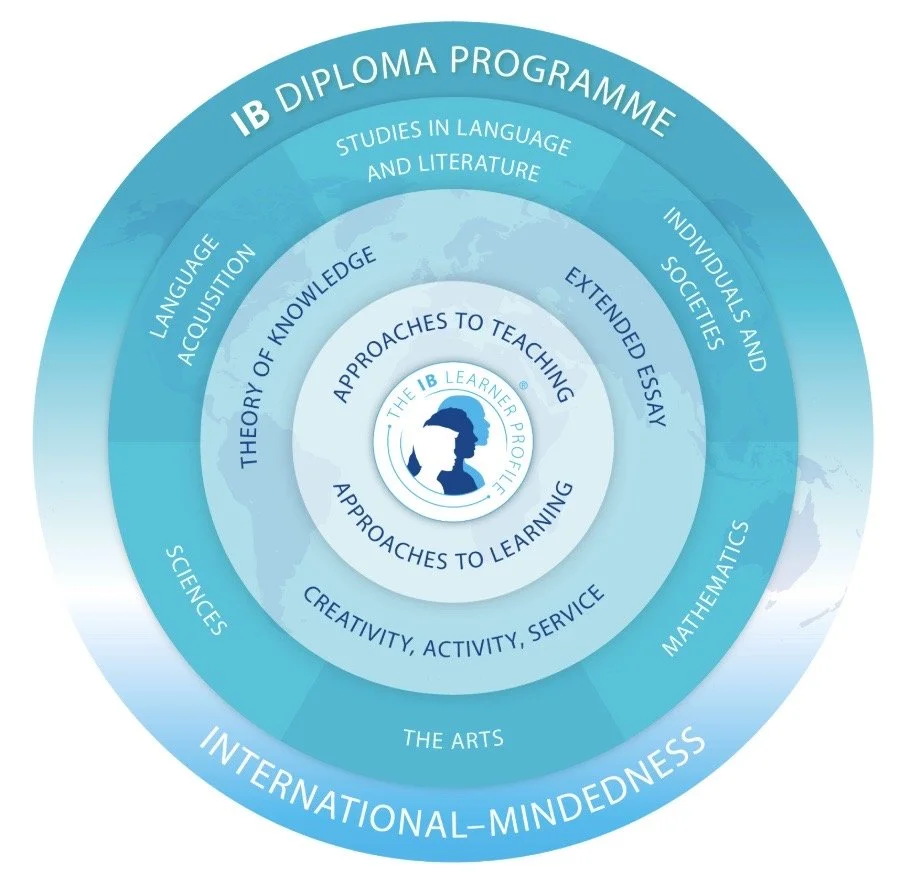
Three subjects are studied in depth at the higher level and three subjects are taken at the more broadly-based standard level. The level chosen reflects the student’s strengths and interests. A higher level subject requires 240 hours of instruction over the two years. A standard level subject requires 150 hours in the two-year period (although in most cases, students receive 220 hours).
The IB DP grading scale ranges from 1 (minimum) to 7 (maximum). Achievement is assessed internally (by the teacher) and by means of external final examinations at the end of the second year. These examinations are set and marked by IB examiners, thereby ensuring that IB Diploma and Course candidates meet the high international standards of the program. Please refer to section 5.8 on Assessment for more details regarding the IBSO table of equivalency.
Additional Diploma Program Requirements:
Theory of Knowledge (TOK)
A unique course called Theory of Knowledge (TOK) is the keystone of the IB DP. TOK aims to make students aware of the interpretative nature of knowledge – including personal ideological biases – whether these biases are retained, revised or rejected.
It offers students and their teachers the opportunity to:
reflect critically on diverse ways of knowing and on areas of knowledge;
consider the role and nature of knowledge in their own culture, in the cultures of others and in the wider world;
be aware of themselves as thinkers, encouraging them to become more acquainted with the complexity of knowledge; and
recognize the need to act responsibly in an increasingly interconnected but uncertain world.
Explore some TOK projects that were showcased this past year.
Creativity, Activity & Service (CAS)
Creativity, Activity & Service (CAS) is at the heart of the DP. It involves students in a range of experiences alongside their academic studies. CAS is the “active” component of a student’s education beyond the classroom. The emphasis is on experiential learning, collaboration and personal growth.
Students are required to:
self-review at the beginning of their CAS experience and set personal goals for what they hope to achieve;
plan, do and reflect (plan activities, carry them out and reflect on what they have learned);
undertake at least two interim reviews and a final review with their CAS Advisor;
take part in a range of significant activities (1 Creativity, 1 Activity, 1 Service and one more of their choosing) and a CAS project which they have initiated themselves;
keep records of their activities and achievements, including a list of the principal activities undertaken; and
show evidence of achievement of the seven CAS learning outcomes.
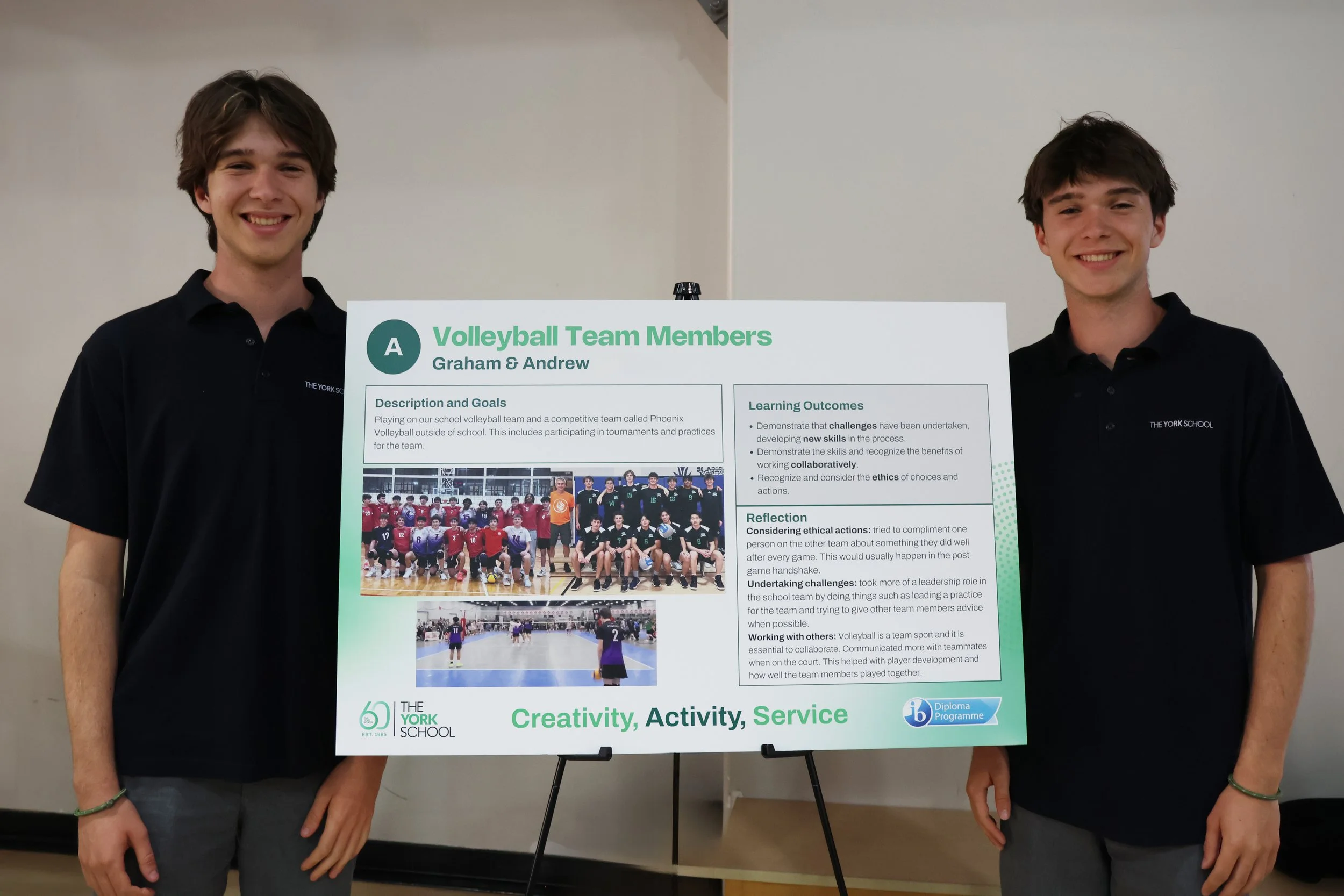
All CAS experiences need to meet the following criteria:
real, purposeful activities with significant outcomes
personal challenge – tasks must challenge the student and be achievable in scope
thoughtful consideration in planning, reviewing progress and reporting
reflection on outcomes and personal learning
The Extended Essay (EE)
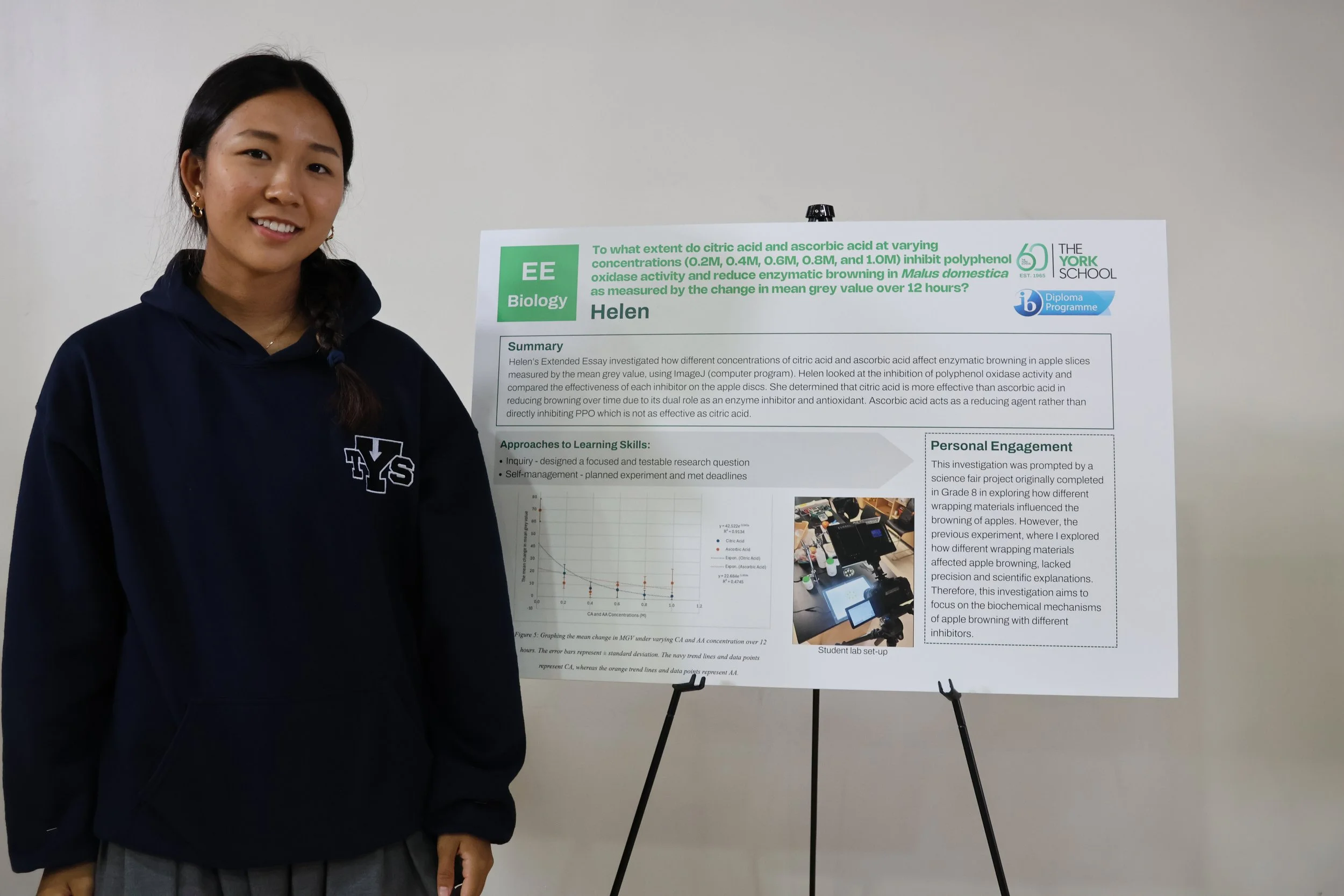
The Extended Essay (EE), a key element of the IB DP, offers students the chance to conduct independent, in-depth research on a topic of personal interest. This 4,000-word project develops critical skills such as research, analysis and time management while fostering intellectual curiosity and resilience. Recognized by universities as excellent preparation for post-secondary studies, the EE equips students with the tools needed for academic success. At The York School, expert supervisors and workshops guide students through this transformative process, ensuring they emerge as confident, self-directed learners ready to make meaningful contributions in university and beyond.
Awarding of the IB Diploma
A total of three additional Diploma Points may be awarded for satisfactory to excellent completion of TOK and the Extended Essay combined.
The IB Diploma is awarded to students whose total score (including additional Diploma Points) is 24 points or more, without any failing conditions as set out by the IB Organization. North American and International universities recognize the standard of an IB Diploma and welcome IB students. In many cases, they offer advanced standing or university credit for DP courses.
Although most TYS students pursue the full IB Diploma Program, the school recognizes that this path may not meet the unique needs of every learner. To address this, students can pursue IB courses through the Personalized Pathway Program (PP), which provides greater flexibility in course selection while maintaining the rigour and benefits of an IB education. This York-designed program allows students to choose a tailored set of IB subjects in Grades 11 and 12, providing options that may not be available within the structure of the full IB DP. Additionally, the program removes the Creativity, Activity, and Service (CAS) requirement and the Extended Essay, enabling students to focus more deeply on their chosen areas of interest. Students who select the PP will graduate with the Ontario Secondary School Diploma (OSSD) rather than the IB Diploma. They will still be credited with six IB DP courses, enhancing their applications to post-secondary institutions.
IB Courses through the Personalized Pathway (PP)
What is required?
Students taking the PP must:
Successfully complete six IB DP courses, including 3 higher level courses.
Successfully complete either the English Literature or English Language & Literature course.
Successfully complete the Theory of Knowledge course.
Adhere to the OSSD’s requirements relating to compulsory credits
Complete 40 hours of community involvement (OSSD requirement)
What is not required?
Students do not need to:
Complete the Creativity, Activity and Service (CAS) program
Complete the Extended Essay (EE)
Adhere to the IB Diploma’s requirements with respect to taking courses from each of the subject areas
Please note that these requirements may be adjusted for documented learning needs or exceptional student circumstances.
Students wishing to pursue IB courses through the Personalized Pathway (PP) must indicate this on their course option form, which is due in February. While every effort will be made to accommodate changes, students who select the PP may or may not be able to transfer to the full IB Diploma Program (DP) at a later date, as this will depend on course availability, scheduling constraints, and the progress made in meeting DP requirements. Families are encouraged to carefully consider their options and consult with their University Counsellor to ensure the best fit for their academic goals.